John Bogle: The Man Who Gave Investors the Index Fund
Bogle built an entire company around a radical idea — that most investors would do better owning the whole market cheaply than trying to beat it.
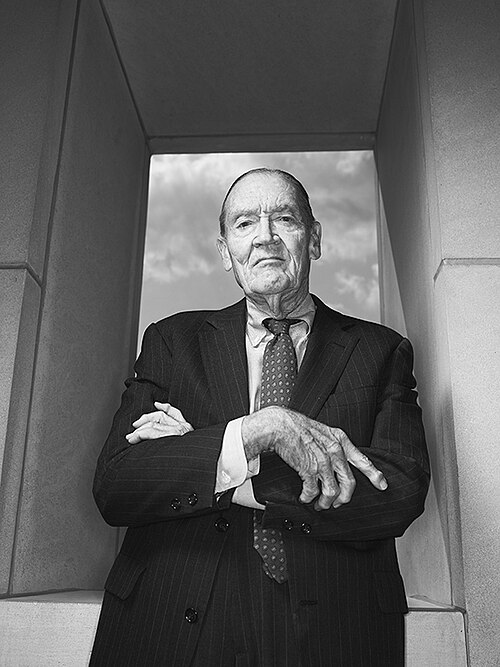
Photo: BillCramer · CC BY-SA 4.0, via Wikimedia Commons
A radical idea: don't try to win, just own the market
John Bogle founded the Vanguard Group in 1975, and a year later launched what became the first index mutual fund available to everyday individual investors, designed simply to track the S&P 500 rather than trying to beat it. At the time, the idea was widely mocked in the investment industry — one competitor reportedly dismissed it as "un-American," since it explicitly gave up on trying to outperform the market. Bogle's bet was that, after costs, most actively managed funds would fail to beat a simple index over the long run, and that individual investors would be better served owning the whole market cheaply than paying for the attempt.
The argument for costs over predictions
Bogle's central argument wasn't really about predicting the market at all — it was about arithmetic. Every dollar paid in fund fees, trading costs, or taxes is a dollar that doesn't compound for the investor, and Bogle argued that since nobody can reliably predict which active managers will outperform in advance, minimizing costs is one of the few genuinely reliable levers an investor actually controls. He often summarized this with a simple line: in investing, you get what you don't pay for.
- Index funds don't try to beat the market — they simply try to match it, as cheaply and reliably as possible.
- Because they don't require analysts picking stocks, index funds can be run at a small fraction of the cost of actively managed funds.
- Over long periods, the majority of actively managed U.S. stock funds have historically underperformed their benchmark index after fees — a body of evidence often cited as vindicating Bogle's original bet.
Structuring the company to prove the point
Bogle didn't just launch a product — he built Vanguard's entire corporate structure around the same idea. Unlike most fund companies, which are owned by outside shareholders seeking a profit, Vanguard is owned by its own funds, which are in turn owned by the investors in those funds. That mutual structure meant Vanguard had no separate outside owner demanding higher profits, letting it pass cost savings back to fund investors as fees came down over time — a structure Bogle designed specifically to keep the company's incentives aligned with its investors rather than with outside shareholders.
Bogle's pitch was almost anti-salesmanship: don't trust us, or anyone else, to beat the market for you. Just buy it, hold it, and keep the cost as close to zero as possible.
A legacy measured in trillions, not headlines
Bogle never had Peter Lynch's flashy multi-year outperformance or Warren Buffett's single-stock picks to point to — his legacy is instead the now-enormous scale of low-cost index investing itself, an approach that has reshaped how trillions of dollars are invested worldwide and materially lowered the cost of investing for millions of individual savers. Warren Buffett, who spent his own career picking individual stocks, publicly credited Bogle in his own shareholder letters as having done more for the average American investor than any other person in the industry.
This article is educational and general in nature. It isn’t personalized investment, tax, or legal advice — always weigh your own circumstances, or talk to a licensed professional, before making financial decisions.
Keep reading
Related guides on this topic.
 ETFs & Index Funds
Do Active Funds Beat the Market? What the 2025 SPIVA Scorecards Show
In 2025 most professionally managed equity funds in Europe and the US lagged their benchmark, and over ten years almost all of them did. What the SPIVA scorecards measure, what they found, and what it means for your savings.
 ETFs & Index Funds
AI, Concentration Risk, and What It Means for Your Index Fund
A handful of large technology companies now account for an unusually large share of major market indexes. Here's what that means if you think of yourself as broadly diversified.
 ETFs & Index Funds
How to Get Investment Exposure to AI Without Picking Individual Stocks
Betting on which individual AI company wins is genuinely difficult. Here's how broad fund categories let investors gain exposure to the trend without picking a single winner.
 Broker Reviews
Fidelity Review 2026: Zero-Fee Funds, Fees, and Who It Suits
Fidelity's zero-expense-ratio index funds made headlines, but its broader case rests on commission-free trading and one of the industry's deepest retirement toolsets.
 ETFs & Index Funds
The S&P 500 Explained: What It Is and Why It Matters
When people say "the market," they usually mean this one index. Here's how it's built, why it's weighted the way it is, and what it leaves out.
 ETFs & Index Funds
Index Funds vs. ETFs: What's the Real Difference?
They often track the exact same index and hold nearly identical portfolios — so what actually separates an index mutual fund from an index ETF?