Terry Smith: Fundsmith, “Do Nothing” and the Year He Changed Course
Terry Smith built Fundsmith into one of Britain’s biggest funds on three rules: buy good companies, don’t overpay, do nothing. After five years behind the market, he rewrote part of the playbook in 2026.
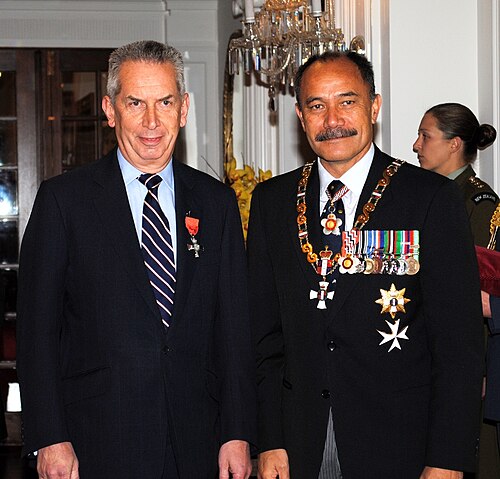
Photo: New Zealand Government, Office of the Governor-General · CC BY 4.0, via Wikimedia Commons
The analyst who lost his job over a book
Terry Smith was born in London in 1953 and made his name in the City as a bank analyst. In 1992, while head of research at UBS Phillips & Drew, he published “Accounting for Growth”, a book showing how well-known British companies used accounting techniques to flatter their profits. The bank tried to stop it, Smith lost his job, and the book became a bestseller. It set the tone for the rest of his career: blunt, sceptical of corporate spin and focused on how much cash a business really produces.
He went on to run the stockbroker Collins Stewart and the interdealer broker Tullett Prebon before setting up Fundsmith in 2010. Its flagship fund, Fundsmith Equity, launched on 1 November 2010.
Buy good companies, don’t overpay, do nothing
Smith’s strategy fits into three short instructions, and he repeats them in almost every letter to investors.
- Buy good companies: businesses that earn high returns on the capital they use, mostly in cash, and can reinvest to grow — think consumer brands, software and medical devices rather than banks, airlines or miners.
- Don’t overpay: a great company can still be a poor investment if you pay too much for it, so valuation matters, measured mainly against free cash flow.
- Do nothing: once you own great companies, the less you trade the better, because trading costs money and great businesses keep compounding.
The fund’s costs are simple too: an ongoing charge of 0.94% a year and no performance fee, which is far more than an index fund costs but easy to understand. For a decade the approach worked brilliantly, and Fundsmith Equity grew into one of the most popular funds among British savers, with about £29 billion at its peak in the early 2020s.
Five years behind the market
Then the market changed. From 2021 Fundsmith trailed the MSCI World index year after year, as many of its consumer and healthcare holdings stalled while a small group of US technology giants drove the index higher. According to interactive investor, over the five years to 8 July 2026 the fund returned 9.5% against 76.3% for the MSCI World, and over ten years it now trailed the index, 145% against 230.2%. Since launch it was still ahead, 593.5% against 526.2%, but the lead had shrunk sharply, and the fund had fallen to about £12 billion.
Smith’s long-run record is still ahead of the index, but anyone who bought Fundsmith in 2021 saw almost none of the market’s gains for five years.
2026: the year he did something
In his letter for the first half of 2026, Smith made the biggest change in the fund’s history. Turnover hit a record 51.8% as he started buying 12 companies and sold, or began selling, 13. Out went long-time holdings such as Unilever, LVMH, Nike, Novo Nordisk and Zoetis; in came companies including Mastercard, Netflix, Uber, GE Vernova, Taiwan Semiconductor (TSMC) and AppLovin. He wrote that the fund would “take more account of momentum — both fundamental and share price” and would be much less willing to buy quality companies after a setback. In the same letter he warned that today’s passive-led momentum market would end “badly”, without saying when.
Critics called it capitulation; supporters called it adapting. Either way, the first half of 2026 was another poor stretch: the fund lost 2.9% while the MSCI World gained 11.2%.
What investors can learn from Smith
Smith’s three rules remain a sensible way to think about owning shares, and his warnings about accounting tricks and trading costs have aged well. His recent years carry a second lesson: even a strategy with a strong long-term record can trail the market for years, and the pressure to change course is greatest exactly when sticking with it is hardest. Before backing any single manager, it is worth asking whether you would hold on through five years like 2021 to 2026. This profile is general education, not a recommendation to buy or sell any fund.
Charlie Munger: mental models and the art of rational investing
The investor whose idea of buying wonderful businesses at fair prices shaped Smith’s approach.
This article is educational and general in nature. It isn’t personalized investment, tax, or legal advice — always weigh your own circumstances, or talk to a licensed professional, before making financial decisions.
Keep reading
Related guides on this topic.
Nick Train: Britain’s Quality-Stock Investor, His 25-Year Record and His Rough Patch
Nick Train built one of Britain’s best long-term records by owning a handful of great brands and rarely selling. Then came five years of painful underperformance. His approach, his numbers, and what his rough patch teaches every investor.
Legendary InvestorsRaamdeo Agrawal: The Co-Founder of Motilal Oswal and His QGLP Approach to Investing
Raamdeo Agrawal arrived in Mumbai to study accountancy, co-founded Motilal Oswal and became one of India’s best-known long-term investors. His QGLP framework, the Hero Honda and Eicher stories, and the lessons for ordinary investors.
Legendary InvestorsAshish Kacholia: India’s “Big Whale” of Small-Cap Investing
Ashish Kacholia started as a broker and analyst, co-founded Hungama with Rakesh Jhunjhunwala and became one of India’s most-watched small-cap investors. His story, his approach, what his portfolio looks like, and why copying it is harder than it seems.
 Legendary Investors
Vijay Kedia: The “SMILE” Investor Who Went From Heavy Losses to Multibaggers
Vijay Kedia lost heavily as a young trader in Kolkata, then became one of India’s best-known small-cap investors with his SMILE approach. His story, the companies that made his name, and why small-cap stock picking is harder than it looks.
Legendary InvestorsPeter Cundill: The Canadian “Indiana Jones” of Value Investing
Peter Cundill travelled the world looking for companies selling for less than their net assets, and grew $10,000 into more than $900,000 over 36 years. His record, his method and his favourite word: patience.
Legendary InvestorsRadhakishan Damani: The Quiet Investor Who Built DMart and Became a Billionaire
Radhakishan Damani left college after a year, made his name on the Mumbai stock market and then walked away to build DMart, one of India’s most valuable retailers. His story, his investing style, and what ordinary investors can take from it.